


SkyPi Studio

Skyler Halisky
Senior technical-support specialist. I turn recurring user friction into documentation, QA, and the tools that fix it.
An accessibility map. A multi‑agent system. A web-based prompt library.
Five projects built, all five on the open web. One is on the App Store in the US and Canada. Accessibility first, built for everyone.
2,900+
0
Round V
The support work
This is the job the projects come from.
- Lane 01EscalationThe escalation point for enterprise accounts.
- Lane 02TroubleshootingCompare cases to separate one-off user error from a repeatable pattern. Reproduce where possible, then isolate variables: app state, device behavior, account state, connectivity, workflow steps. The output is a likely cause, or the right escalation path.
- Lane 03Documentation and QAReproducible steps, expected versus actual behavior, the conditions that matter, and any workaround or known limitation. Fixes and workflows get verified against the original support scenario and its nearby edge cases before anything is called resolved.
- Lane 04TrainingTraining and coaching teammates.
- Lane 05Support to productAnd the tools that fix it. Flagstone is the clearest case: accessibility software built because disabled people deserve navigation tools designed for them, not adapted for them.
The Work
A handful of things, made with intention.
Flagstone
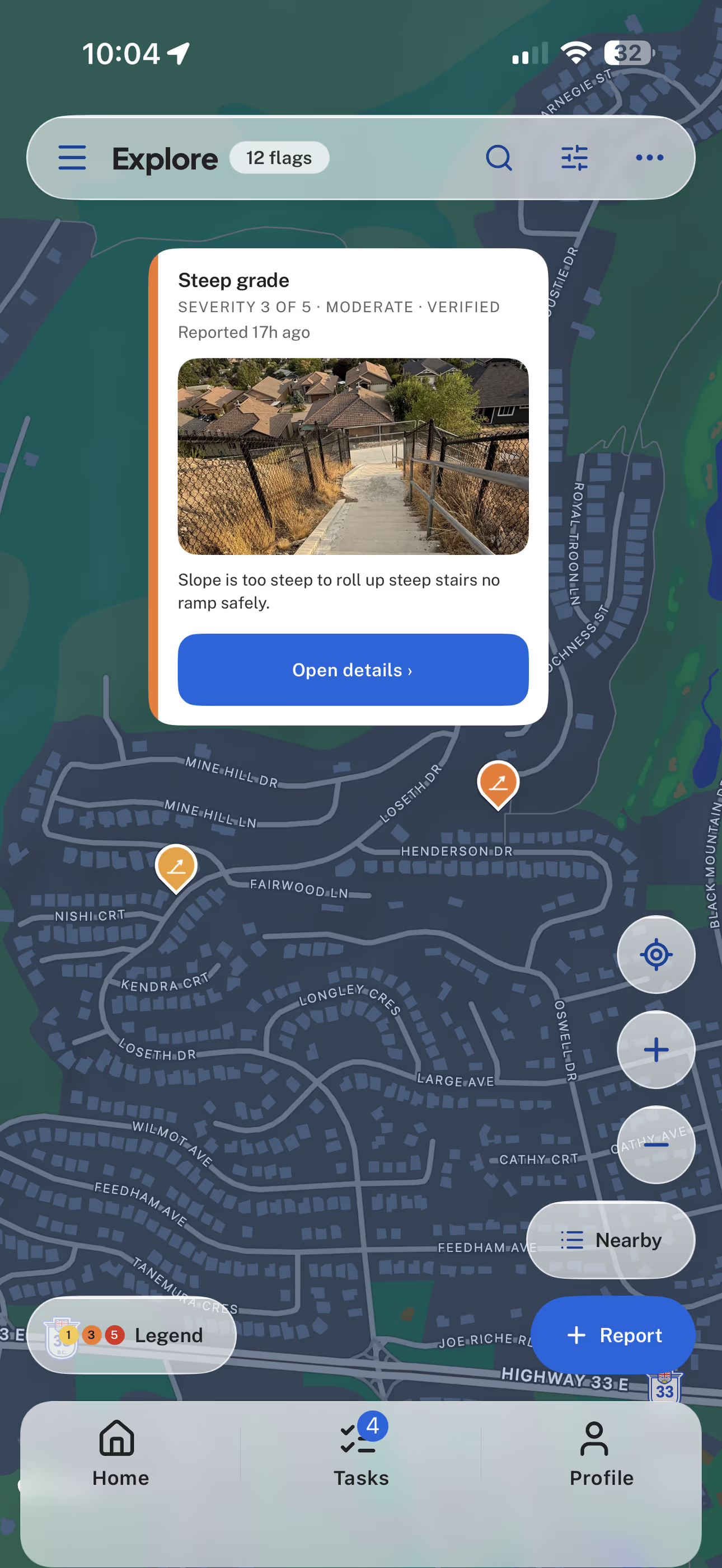
Community map of accessibility barriers: report a broken ramp, verify a neighbour's, see it marked fixed. Privacy-first: no ads, no analytics, no trackers.
View projectClaude Corp
A governed multi-agent development system I designed and operate: 15 AI roles, a written Constitution, review gates, and autonomy bounded by explicit rules.
View projectClaude Corp Dashboard
The operator console for my agent team: what needs me, what is blocked, how each project is doing. Private in use; a public demo runs on synthetic data only.
View projectPrompt Library
Prompts as reusable assets, not scattered text: organize, search, fill variables, run. Kept in your browser; each run goes straight to Anthropic with your key.
View projectGhost Code
A terminal-command trainer and my first real build, made to get fluent in the command line and Claude Code. 56 cards, Arcade and Learn modes, no dependencies.
View project
The Record
The last thing I got wrong is in here too.
- Round VThe Room: 11 phases · 10 shipped · 1 held · axe 0 violations · 34 scans · the record
- Last defectthe dead Report button: found by a simulator walk, fixed by one moved closing tag, re-proven by a test that fails against the old arrangement · the account
- 2.2 AAthe bar I build to: pixel-contrast at the measured coordinates · the statement
- 100%focus stops visible: every tab stop, keyboard-traced · evidence
How the work gets made
I direct AI agents, and I built the system that keeps them honest.
The projects above were implemented by AI agents working inside a governance system I designed: fifteen roles with explicit domain boundaries, and a written constitution that outranks any individual role or prompt. The agents do the implementation, the tests, and most of the diagnosis. I set the problem, make the architectural calls, and gate what lands.
The constraints are what make the output reviewable. Database migrations are files with a rollback, never applied changes: no agent applies one to production, or sends anything outside the repository, without my explicit authorization under a narrow, mechanically gated exception. None handles credentials. Exactly one of the fifteen may message me; the rest write to files I read on my own schedule. Merges to main are mine, with one narrow gated exception I granted to a single project.
Here is the system working. An agent fixing something unrelated added two background-location permission strings to app.json. The privacy role blocked it: the app uses no background-location APIs, so declaring them would invite an App Store 5.1.1 rejection and ask for a permission the product does not need. Both keys were removed; neither reached main.
And here is what it hands back. A review found that anonymous reports skipped a content filter that signed-in reports run. It was written up and deliberately left unpatched, because deciding what to filter on a submit form is a moderation policy, not a bug fix. It waited for me instead of being quietly patched, and the filter runs on both paths now.
The honest limit: these fences are prompt-level, not sandbox-level. It is one person’s system, tested across one person’s projects, and some of the governance overhead does not pay for itself.
A Brief Account
The work is careful. The record is honest.
One careful deliverable beats a dozen rough ones.
Most of what I make starts with a problem worth solving. I prefer small, exact software to large, approximate software. I work from Canada, mostly on AI tooling, accessibility infrastructure, and the systems that make a product feel calm.
I keep a written record of how each thing was made. The documentation is part of the deliverable, not an afterthought.
The full accountCredentials, earned in order: 9 of them, with issuers and dates. See the credential badges
Let’s talk